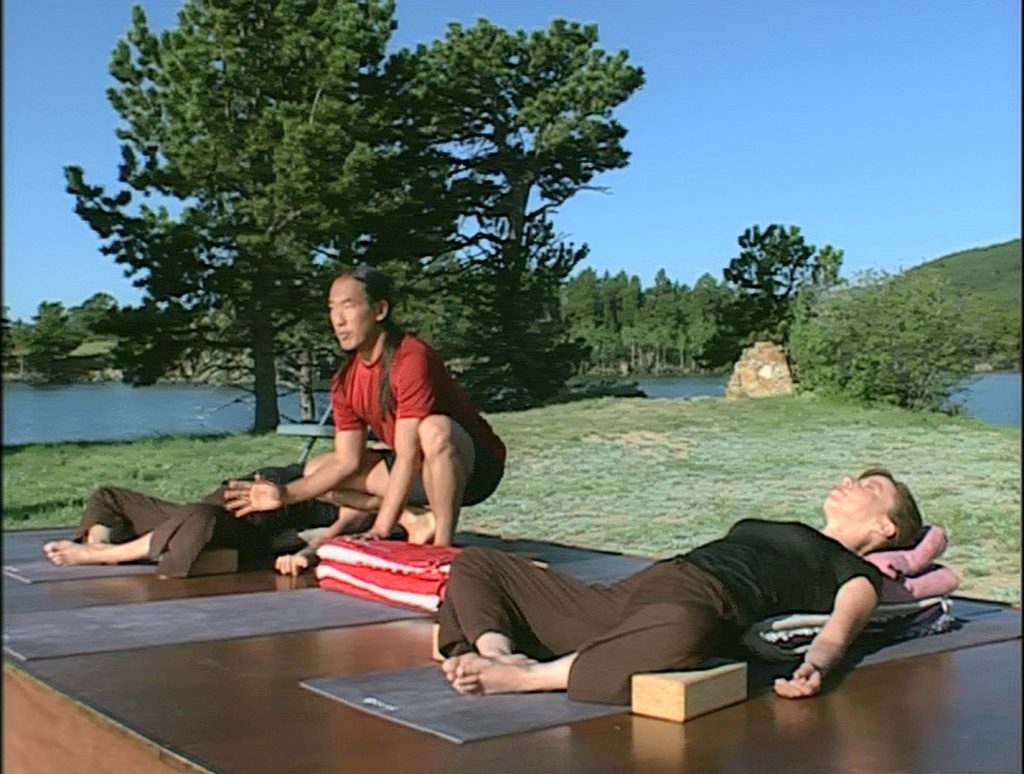
* Please note: the name of the overall pose is actually the Supported Bound Angle Pose
About the Author: Lou Paré-Lobinske is 59 years old and based in north Florida, USA. She is a published poet and journalist and has a freelance editing business. She also has two blogs and a Patreon because she doesn’t have enough to do. She has had fibromyalgia for 28 years. She lives with her husband of 39 years and their four cats.
There is a quiet but powerful misconception that follows many people living with fibromyalgia and chronic illness: the belief that if you are not constantly doing, producing, or keeping up, you must be lazy.
It is a harsh and deeply unfair label—one that often comes not only from others, but from within.
But what if the truth is something entirely different?
What if you are not lazy at all… but instead, you are managing your energy in a way that most people never have to think about?
Living with fibromyalgia means living in a body where energy is not predictable, steady, or unlimited. It comes in waves. Some days offer a small window of clarity and movement. Other days feel heavy before they even begin. This is not a failure of effort. It is a reality of the condition.
Yet we live in a world that measures worth by output.
We are praised for doing more, pushing harder, staying busy. Rest is often seen as something to be earned after productivity. And so, when your body asks you to slow down, to stop, or to do less, it can feel like you are somehow falling short.
But you are not falling short.
You are adapting.
Energy management is not laziness—it is awareness. It is learning how to live within your limits without constantly harming yourself in the process. It is making choices, often difficult ones, about where your energy goes and what truly matters.
You may look at your day and see fewer tasks completed than you had hoped. But what you may not see—what others certainly do not see—is the invisible work happening beneath the surface. The effort it takes to get out of bed. The strength required to move through pain. The mental focus needed to stay present through fatigue.
This is not laziness. This is resilience.
Managing energy also means learning to listen to your body before it forces you to listen. It means recognizing early signs of depletion and responding with care rather than resistance. It means allowing yourself to rest not because you have “earned” it, but because you need it.
This shift can be incredibly challenging, especially if you have spent years pushing through and measuring yourself against others. Letting go of that mindset takes time. It requires you to redefine what productivity and success look like in your life.
Perhaps success is not about how much you accomplish in a day, but how well you honor your needs.
Perhaps productivity includes rest, reflection, and recovery.
Perhaps doing less is not a step backward, but a step toward sustainability.
There is also courage in setting boundaries around your energy. Saying no when something is too much. Choosing one meaningful activity instead of many draining ones. Giving yourself permission to stop before you reach complete exhaustion.
These are not signs of weakness. They are signs of self-respect.
You are learning how to live in a way that supports your well-being, not undermines it.
And that matters.
So the next time that voice whispers that you are not doing enough, pause for a moment. Consider what you are doing. Consider the effort it takes to navigate your days with care and awareness.
You are not lazy.
You are thoughtful. You are adaptive. You are strong in ways that are not always visible.
You are managing your energy—and that is a skill, a strength, and a quiet form of wisdom that deserves to be recognized.
As I sit here at 6:30 a.m., with Mom’s balcony curtains wide open and the door cracked just enough to let in a bit of fresh air, I think: blessed is the quiet. The cars are passing, the birds are singing, but for a short time there is peace in this home. I have pain like no other today, and if I were at my own house, I’d still be in bed or on the couch, looking out our big, beautiful windows at the farmers’ fields, letting the quiet wrap around me like a hug.
But instead, I’m here — hands trembling around a warm cup of tea. I just heard Mom stir and prayed she would go back to bed for a little while longer. I need to gather my strength for the day ahead.
Soon enough she’ll be up, and the entertainment will begin. The radio will go on far too loud, drowning out her own voice, and the TV will follow with her beloved shows. The PSW is supposed to come around 9 a.m. to give her breakfast, coffee, and pills, but sometimes it’s closer to 11. Too late for breakfast, too late for medication, too late for coffee — so I make sure she gets all three.
The other day I went home for a break, leaving her with a casserole she could microwave, raisin bread, bananas, coffee, milk, and cream. But just as I walked through my own door, she called, saying she needed me. Her eye was sore, and she couldn’t get her drops in. I can barely get them in either — my hands tremble, my arms ache. My husband cursed under his breath: You’re exhausted, you can barely move, and now you’re doing laundry and packing to go back after just unpacking.
He wasn’t wrong. It was the last thing I wanted to be doing. But I’m the only one, so I go. It doesn’t matter how I feel because my mother needs me, and I’m “such a good daughter for looking after my mother and her needs.” I smile and say thank you.
I love my mother, but looking after her is too much for me. Getting her help is years down the list, and she’s only considered a crisis because a few people are ahead of her for long-term care. As much as I don’t want to see her go, it’s what she needs. Even her friends say she should have gone sooner. But Mom is always “fine,” and “my daughter can help me.” What she means is: my daughter can wait on me.
When I got back to her place, of course she hadn’t eaten properly. She didn’t see the casserole, but she saw the lemon meringue pudding cup and the ice cream bars. I heated the casserole anyway, and she happily ate.
I’ve explained to her that if she wants something from the store, it has to be in the morning. By afternoon, I’m too tired and it’s too warm. But yesterday she kept bugging me for a walk. Mom doesn’t know the word no.
So off we went in the blazing early evening heat to get a burger. I barely made it — my knees ready to give out, my head pounding, every muscle feeling beaten with a baseball bat. But whatever Mom wants.
She ordered her burger to go. I told her I needed a drink with mine and that I was eating there. She wasn’t impressed, clearly annoyed, but she stayed. I ordered and paid for mine — root beer was the only drink. She stayed silent while we waited, and I had nothing left to say. I was seeing stars and praying the burger would give me enough strength to get back.
I finished first. She said she’d finish hers at home. I wanted to sit and enjoy my drink, but instead we left. I trailed behind her, telling her to go ahead because she moves faster with her walker than I do with my cane.
Back at the apartment, I went straight to my room and stripped down to my underwear, grabbing the fan. I told her the fans were in the bedroom, but she insisted they were in the storage room. I didn’t argue. I just went to her closet, brought one out for her, put the other in my room, and sat in front of it. My body needed to cool down before I could even think about a shower.
She wasn’t happy that I wasn’t sitting out with her. But I had nothing left to give. I was fighting back tears, having taken all my medication early along with extra-strength Tylenol, praying for a miracle. She kept asking if I was alright. I told her I was fine. What’s the point of telling her the truth? She won’t listen. She can’t.
But oh, I’m such a good daughter looking after my mom.
I hear her now.
Peace has left, and life begins yet again.
About the Author: Wendy Fleming was born and raised in London, Ontario. She currently lives in Aylmer with my husband of 30 years. They have three daughters. She loves expressing herself with words and is in the process of publishing her first book and writing and revising her second. She also loves teaching others to live their best life with chronic illness.