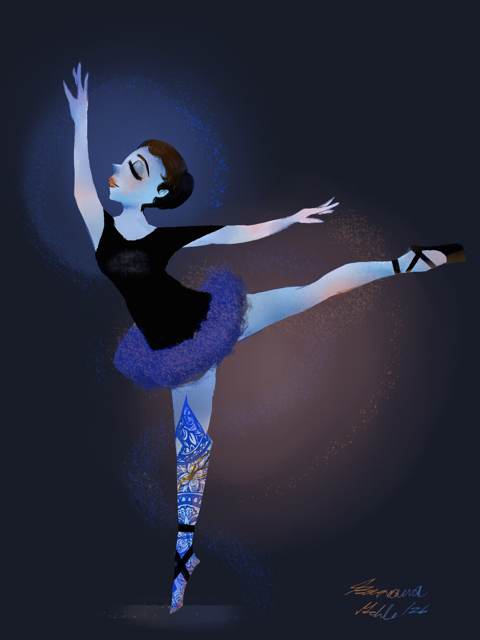
This digital art piece introduces us to a dancer caught between grace and limitation. At first glance, the ballerina appears poised, almost suspended in a moment of elegance. Yet the illusion of effortless movement is quietly interrupted by her porcelain leg—fragile, rigid, and unyielding. It becomes the focal point of the image, symbolizing both vulnerability and resilience.
The use of orange and blue tones deepens this emotional tension. Orange radiates warmth, intensity, and even discomfort, suggesting the internal heat of pain or inflammation. In contrast, blue conveys coolness, stiffness, and restraint, evoking the immobilizing quality of physical limitation. Together, these colours create a visual dialogue between movement and restriction, vitality and stillness.
What makes the image especially compelling is its honesty. This is not simply a depiction of a dancer, but of the lived experience behind the performance—the quiet negotiation between what the body longs to do and what it is able to do. The porcelain leg does not diminish the ballerina’s beauty; instead, it reframes it. Strength, here, is not found in perfection, but in persistence.
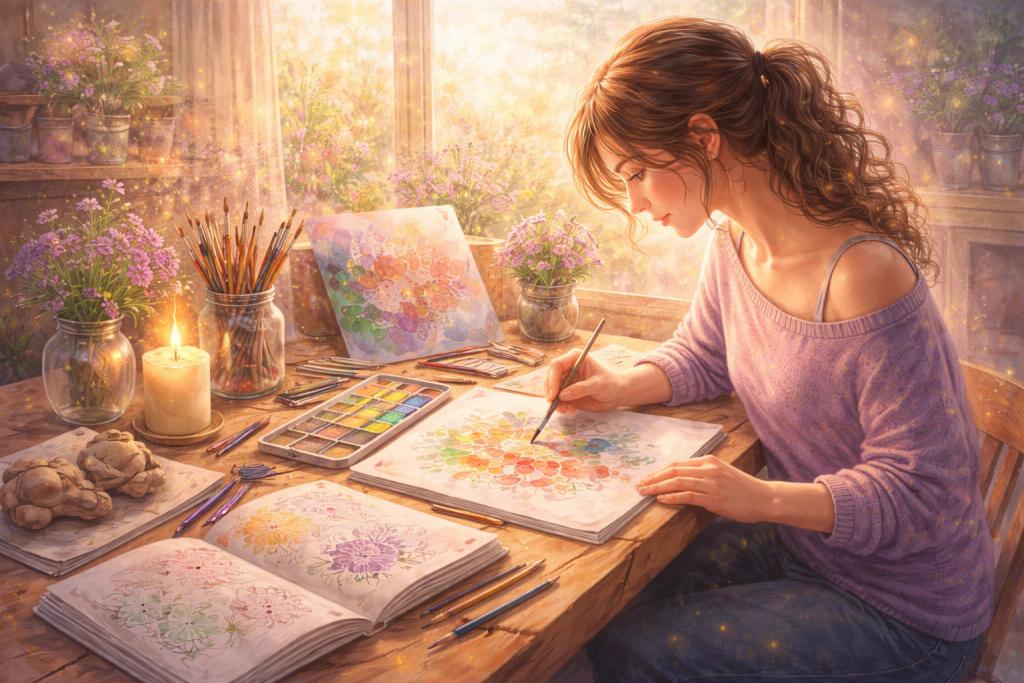
There are moments, even in the midst of fibromyalgia, when time seems to soften. When the mind becomes absorbed in a task, and for a little while, pain fades into the background. This experience is often referred to as “flow”—a state of deep engagement where awareness narrows and creativity takes the lead.
For those living with fibromyalgia, entering flow can feel elusive, but when it happens, it is deeply restorative.
Flow does not require high energy or long stretches of uninterrupted time. It can emerge in small windows—a few minutes spent arranging words on a page, stitching fabric together, or shaping clay with your hands. What matters is not the duration but the depth of engagement.
When you are in a state of flow, your attention is gently but fully focused. The mind is not preoccupied with pain, appointments, or fatigue. Instead, it is absorbed in the process of making. This shift in attention can create a sense of relief, even if temporary.
There is also a quiet joy that comes from creating something beautiful. Beauty, in this context, is not about perfection. It is about authenticity. A poem written from the heart, a simple sketch, or a handmade object carries a kind of beauty that is rooted in truth.
For individuals with fibromyalgia, beauty can become a form of resistance. It says: despite pain, something meaningful can still be created. Despite limitations, expression is still possible.
Entering flow often requires gentleness. It cannot be forced. Instead, it is invited. Creating a calm environment, setting aside even a small amount of time, and approaching your work without pressure can help open the door.
It is also important to release expectations. Flow is not about producing a masterpiece. It is about being present. Some days, you may only touch the surface of that experience. Other days, you may find yourself fully immersed. Both are valuable.
The joy of making something beautiful is not only in the finished product—it is in the process itself. It is in the quiet moments of concentration, the subtle shifts in attention, and the feeling of being connected to something beyond pain.
What is especially meaningful is how these moments begin to reshape your relationship with your body. Instead of seeing your body only as a source of limitation, you may begin to experience it as a collaborator—one that moves at a slower pace, yes, but still capable of expression and creation. This shift can be deeply healing.
You may also notice that flow brings a sense of timelessness. Minutes feel fuller, richer. Even brief creative sessions can leave a lasting emotional imprint, offering a sense of accomplishment and calm that carries into the rest of your day.
Over time, these moments of flow can become part of your coping toolkit. They offer not only distraction but nourishment. They remind you that your inner world remains rich, creative, and alive.
Even in a body that struggles, the capacity to create beauty endures. And in that creation, there is joy.
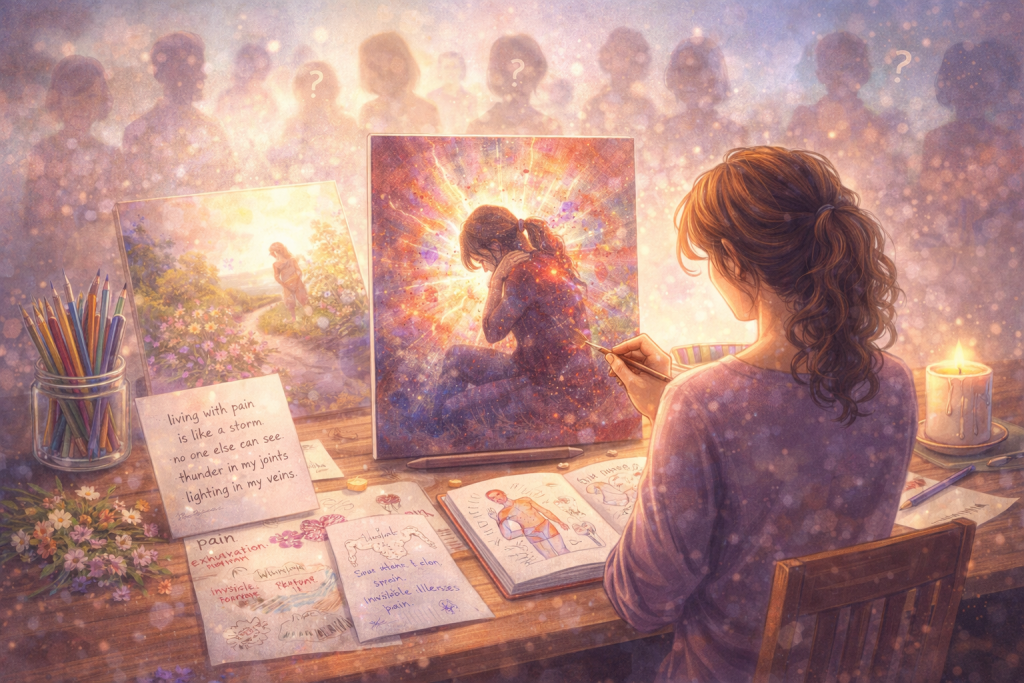
Fibromyalgia is often an invisible illness. Many individuals live with symptoms that are not immediately apparent to others, which can lead to misunderstanding, dismissal, or lack of awareness. In this context, art can become a powerful form of advocacy.
Creative expression allows you to share your story in ways that go beyond explanation. A poem, a painting, a piece of music, or even a short narrative can communicate the lived experience of fibromyalgia more vividly than clinical descriptions ever could.
Art has the ability to make the invisible visible.
When you create from your own experience, you are offering others a window into your world. You are helping people understand what it feels like—not just what it is. This kind of understanding can foster empathy, which is at the heart of meaningful advocacy.
Importantly, advocacy through art does not require you to be public in ways that feel uncomfortable. You can share your work with a small group, within a supportive community, or even keep it private. The act of creating is itself a form of reclaiming your voice.
For those who choose to share more broadly—through blogs, social media, or community events—creative work can contribute to larger conversations about chronic illness. It can challenge misconceptions and highlight the realities of living with fibromyalgia.
Art also allows for nuance. Fibromyalgia is not a single story. It includes pain, yes, but also resilience, adaptation, humour, and moments of joy. Creative expression can capture this complexity in ways that simple descriptions cannot.
There is also empowerment in telling your own story. When others speak about chronic illness without lived experience, important aspects can be overlooked. By sharing your voice, you ensure that your reality is represented authentically.
Advocacy through art is not about perfection or persuasion. It is about presence. It is about saying: this is what it is like for me.
In doing so, you may find that others resonate with your work. They may feel seen, understood, or less alone. This connection is one of the most powerful outcomes of creative advocacy.
At the same time, it is important to approach this work with self-compassion. Sharing your story can be vulnerable. It is okay to move at your own pace and to set boundaries around what you share.
Ultimately, art as advocacy is about bridging gaps—between experience and understanding, between isolation and connection.
Your story matters. And when expressed creatively, it has the potential to reach hearts in ways that words alone often cannot.