
By Irene Roth/Blog Editor
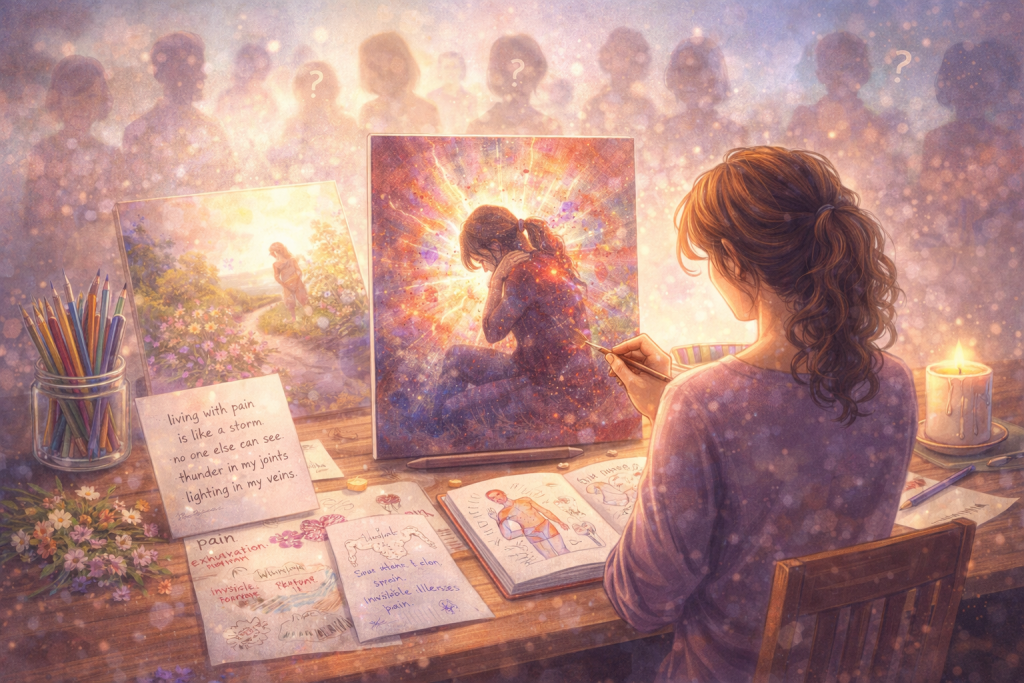
Fibromyalgia is often an invisible illness. Many individuals live with symptoms that are not immediately apparent to others, which can lead to misunderstanding, dismissal, or lack of awareness. In this context, art can become a powerful form of advocacy.
Creative expression allows you to share your story in ways that go beyond explanation. A poem, a painting, a piece of music, or even a short narrative can communicate the lived experience of fibromyalgia more vividly than clinical descriptions ever could.
Art has the ability to make the invisible visible.
When you create from your own experience, you are offering others a window into your world. You are helping people understand what it feels like—not just what it is. This kind of understanding can foster empathy, which is at the heart of meaningful advocacy.
Importantly, advocacy through art does not require you to be public in ways that feel uncomfortable. You can share your work with a small group, within a supportive community, or even keep it private. The act of creating is itself a form of reclaiming your voice.
For those who choose to share more broadly—through blogs, social media, or community events—creative work can contribute to larger conversations about chronic illness. It can challenge misconceptions and highlight the realities of living with fibromyalgia.
Art also allows for nuance. Fibromyalgia is not a single story. It includes pain, yes, but also resilience, adaptation, humour, and moments of joy. Creative expression can capture this complexity in ways that simple descriptions cannot.
There is also empowerment in telling your own story. When others speak about chronic illness without lived experience, important aspects can be overlooked. By sharing your voice, you ensure that your reality is represented authentically.
Advocacy through art is not about perfection or persuasion. It is about presence. It is about saying: this is what it is like for me.
In doing so, you may find that others resonate with your work. They may feel seen, understood, or less alone. This connection is one of the most powerful outcomes of creative advocacy.
At the same time, it is important to approach this work with self-compassion. Sharing your story can be vulnerable. It is okay to move at your own pace and to set boundaries around what you share.
Ultimately, art as advocacy is about bridging gaps—between experience and understanding, between isolation and connection.
Your story matters. And when expressed creatively, it has the potential to reach hearts in ways that words alone often cannot.
Hi Sue,
I’m so glad that your artwork really helped. It really is therapy. I love that.
I hope you can pursue your art again soon!
Take care,
Irene
I started art classes in high school and even did a self portrait as part of my classes but it was stolen or misplaced when I went to pick up my folder at the end of the semester. Kind of disappointing but I guess someone needed it more then I did. Over the years, I have continued to work with different forms of art, whether painting, sketching, pottery, and even did an art therapy course by making my own greeting cards for friends and family after my mom passed on Dec 29 2019 as I couldn’t get grief counseling due to the pandemic. Doing all kinds of art has helped me deal with grief, anxiety, depression, fibromyalgia and physical pains over my whole life of 54 years so I deeply suggest others use it as they wish to help with life’s bumps in the road or just for fun. Meditation is also very helpful and I have found lots of free courses online or people may apply for scholarships too as money is not always available. Many Blessings Amen