
by Irene Roth/Blog Editor
There are moments, even in the midst of fibromyalgia, when time seems to soften. When the mind becomes absorbed in a task, and for a little while, pain fades into the background. This experience is often referred to as “flow”—a state of deep engagement where awareness narrows and creativity takes the lead.
For those living with fibromyalgia, entering flow can feel elusive, but when it happens, it is deeply restorative.
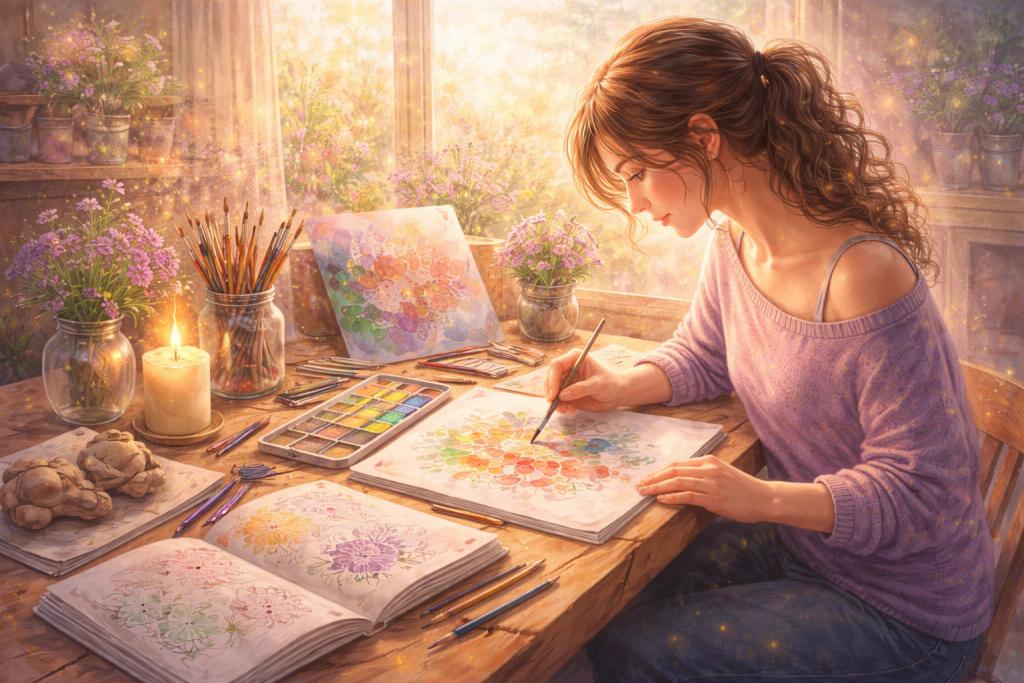
Flow does not require high energy or long stretches of uninterrupted time. It can emerge in small windows—a few minutes spent arranging words on a page, stitching fabric together, or shaping clay with your hands. What matters is not the duration but the depth of engagement.
When you are in a state of flow, your attention is gently but fully focused. The mind is not preoccupied with pain, appointments, or fatigue. Instead, it is absorbed in the process of making. This shift in attention can create a sense of relief, even if temporary.
There is also a quiet joy that comes from creating something beautiful. Beauty, in this context, is not about perfection. It is about authenticity. A poem written from the heart, a simple sketch, or a handmade object carries a kind of beauty that is rooted in truth.
For individuals with fibromyalgia, beauty can become a form of resistance. It says: despite pain, something meaningful can still be created. Despite limitations, expression is still possible.
Entering flow often requires gentleness. It cannot be forced. Instead, it is invited. Creating a calm environment, setting aside even a small amount of time, and approaching your work without pressure can help open the door.
It is also important to release expectations. Flow is not about producing a masterpiece. It is about being present. Some days, you may only touch the surface of that experience. Other days, you may find yourself fully immersed. Both are valuable.
The joy of making something beautiful is not only in the finished product—it is in the process itself. It is in the quiet moments of concentration, the subtle shifts in attention, and the feeling of being connected to something beyond pain.
What is especially meaningful is how these moments begin to reshape your relationship with your body. Instead of seeing your body only as a source of limitation, you may begin to experience it as a collaborator—one that moves at a slower pace, yes, but still capable of expression and creation. This shift can be deeply healing.
You may also notice that flow brings a sense of timelessness. Minutes feel fuller, richer. Even brief creative sessions can leave a lasting emotional imprint, offering a sense of accomplishment and calm that carries into the rest of your day.
Over time, these moments of flow can become part of your coping toolkit. They offer not only distraction but nourishment. They remind you that your inner world remains rich, creative, and alive.
Even in a body that struggles, the capacity to create beauty endures. And in that creation, there is joy.
Top of Form
Bottom of Form
Hi Lainne,
It sure does. I hope you continue your art to get all the brain benefits.
I also lead a writing program through FSN. If you like writing or journaling, I would love to have you.
Take care, and thank you for visiting our blog and leaving a message.
Irene
This is so true! I am an artist and have experienced flow often. I have taken Neuroplasticity courses which help change the brain neuro-pathways. Flow or creative redirection is a technique used to reduce the pain pathways. Using multiple techniques I have reduced my pain level.