
Reviewed by Irene Roth/Blog Editor
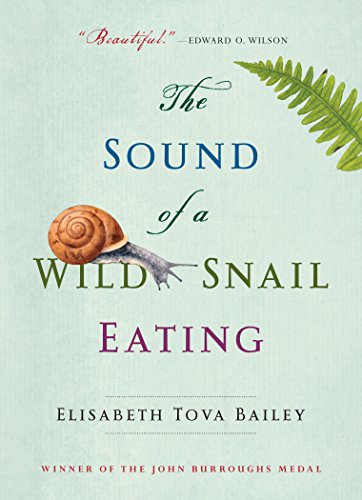
There are some books that arrive quietly but leave a lasting imprint on the heart. The Sound of a Wild Snail Eating by Elisabeth Tova Bailey is one of those rare and gentle memoirs. For fibromates and others living with chronic illness, this book offers something deeply needed: validation, comfort, and hope.
Bailey’s story begins with a sudden and severe illness that leaves her almost completely bedridden. Once active and independent, she finds herself unable to walk, work, or even sit upright for extended periods. Her world shrinks to the confines of her bedroom, and with that shrinking comes isolation, frustration, and the quiet grief of losing the life she once knew. Many fibromates will immediately recognize this experience—the abrupt shift from capability to limitation, and the emotional adjustments that follow.
Everything begins to change when a friend brings her a small pot of violets, and within it, a tiny wild snail. At first, the snail seems insignificant. But over time, Bailey begins to observe it closely. She watches its slow movements, its persistence, and its quiet routines. This tiny creature becomes a companion, but more importantly, a teacher.
Through observing the snail, Bailey begins to rediscover meaning in stillness. The snail moves slowly, but it moves with purpose. It survives. It adapts. It continues. In its quiet existence, Bailey finds reassurance that life does not need to be fast to be meaningful. This message is especially powerful for fibromates, who often must live at a slower pace than the world around them.
One of the most beautiful aspects of this memoir is its gentle honesty. Bailey does not deny the hardship of chronic illness. She acknowledges the loneliness, the dependence on others, and the uncertainty. Yet the book never feels depressing. Instead, it feels peaceful. It reminds readers that even in limitation, there can be beauty, connection, and growth.
The natural imagery throughout the book reinforces its hopeful tone. The presence of the snail, the violets, and the changing light in her room all symbolize quiet renewal. Like early spring, healing in this memoir is subtle and gradual. It does not arrive suddenly, but it does arrive.
For fibromates, this book offers a powerful and comforting message: your life still has value, meaning, and richness, even when your body has changed. It gently encourages readers to release harsh expectations and to embrace self-compassion. It reminds us that rest is not weakness, and that slowing down can open new ways of seeing the world.
Ultimately, The Sound of a Wild Snail Eating is a memoir about resilience—not the loud, dramatic kind, but the quiet, steady resilience of continuing. It is a story of learning to live differently, and of finding hope in the smallest and most unexpected places. For anyone living with fibromyalgia or chronic illness, this book feels like a calm and reassuring companion, offering the gentle reminder that even after the longest winter, spring always returns.
Hi Samantha,
I’m so glad to hear this! This is quite a good book, and I’m sure you’ll enjoy it. I’m always on the lookout for books that show us that we can be resilient and hopeful, regardless of what we’re living with.
Take good care, and thank you for leaving a comment!
Irene
This book sounds just like what I need. I must learn to pace myself and appreciate slowing down. I love reading good books that inspire me to do what is best for me, and that flame my passion again.
Hi Rose,
I’m so glad to hear that! Thank you so much!
Take care, and have an awesome day!
Irene
Beautiful! Thank you for sharing! Even the review gives me a hopeful perspective into my pace.