

by Irene Roth, Blog Editor/Writer
Living with chronic illness, like fibromyalgia or other invisible conditions, often feels like walking a tightrope between what you want to do and what your body can actually handle. For many, the concept of energy pacing becomes essential. It’s a way to honor your limits while still living a fulfilling life. At the heart of this approach is the Spoon Theory, a metaphor that has helped countless individuals visualize their energy reserves and plan their days thoughtfully.
Spoon Theory was coined by Christine Miserandino, who used spoons to describe the finite energy people with chronic illnesses have each day. In this analogy, healthy individuals might have a seemingly endless supply of “spoons” — the units of energy needed to complete daily tasks. For someone with a chronic illness, spoons are limited. Every activity, from showering to grocery shopping, costs a spoon. Once your spoons are gone, exhaustion or symptom flare-ups can occur.
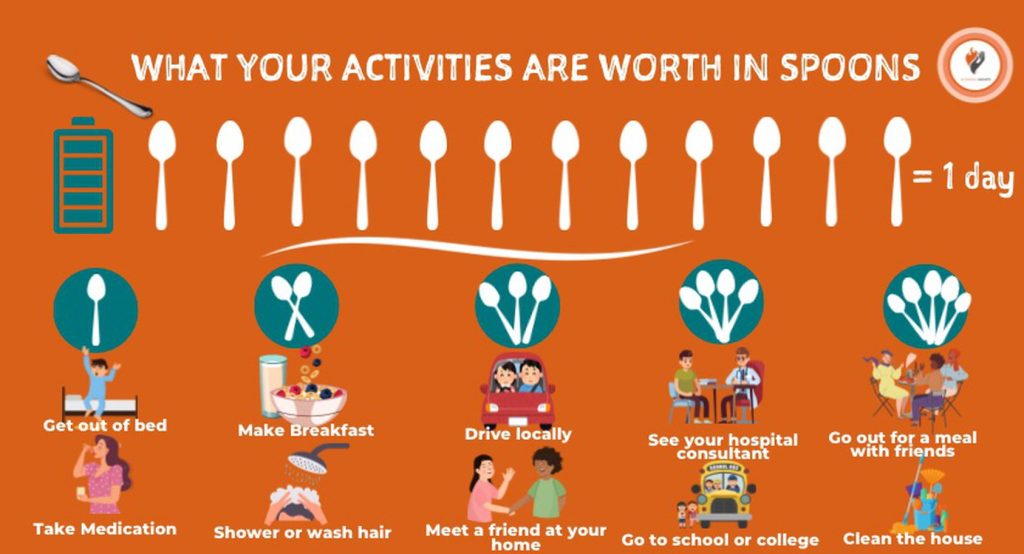
The beauty of Spoon Theory lies in its simplicity. It helps friends, family, and coworkers understand that fatigue is not laziness or avoidance; it’s a matter of managing limited resources wisely.
Energy pacing is the strategy of allocating your limited spoons throughout the day to prevent overexertion and setbacks. It’s about working with your body rather than against it. Here’s how it looks in action:
Each morning, take a moment to mentally inventory your energy. How many spoons do you have today? This can change depending on sleep quality, stress, weather, or symptoms. Being mindful of your baseline allows for realistic planning.
Not all tasks carry equal importance. Identify which activities are non-negotiable and which can wait. For instance, attending a medical appointment might take priority over organizing your closet. Use your spoons where they matter most.
Here are a few ways to do this:
Break Tasks Into Manageable Steps
Instead of tackling a big task in one go, break it down into smaller steps. Doing dishes, for example, might be divided into washing, drying, and putting items away across the day. Small increments help avoid burning through your spoons too quickly.
Build in Rest Periods
Pacing isn’t just about conserving energy for tasks; it’s also about scheduling rest proactively. Naps, quiet time, or short walks can replenish energy levels and prevent the dreaded crash that comes from pushing too hard.
Track and Adjust
Keeping a journal or digital tracker can help you notice patterns. Which activities drain you the most? Are there times of day when you have more energy? This feedback is invaluable for fine-tuning your pacing strategy.
Here’s an example to bring the points in focus from this blog.
Imagine a fibro warrior named Sara. She wakes up with six spoons. Showering costs one spoon, preparing breakfast two spoons, and a short walk three spoons. Without pacing, she might try to clean the house after her walk, quickly running out of energy and triggering a flare-up. Instead, Sara might choose to do light tidying in 10-minute increments across several days, preserving spoons for activities that bring her joy, like reading or spending time with family.
Energy pacing and Spoon Theory aren’t just physical tools—they’re empowering. They give control back to those living with chronic illness, validating limits while encouraging intentional, meaningful activity. By accepting that energy is a precious, finite resource, you can reduce guilt and frustration, focusing instead on what truly matters.
Living with limited energy can be challenging, but Spoon Theory and energy pacing transform how we navigate daily life. By consciously managing spoons and strategically planning activities, fibro warriors can protect their well-being, avoid crashes, and still enjoy life’s simple pleasures. The goal isn’t to do everything; it’s to do what matters most, with balance and self-compassion.
Hi Sandy,
Thank you for your kind words!
Yes, the spoon theory is quite complicated to understand. This is because it is so individual.
I feel with myself, if I got a good night’s sleep I have more spoons than if I don’t get enough sleep.
If I have more pain and less sleep, I feel I have fewer spoons.
So, it is very temperamental. I think the idea maybe with spoon theory is just for us to become more aware of how we are feeling and to pace according to what our energy levels are and not pushing through and making ourselves feeling even more overwhelmed?
The gas tank approach is a lot easier to understand. So, use whatever works best for you to determine your energy levels.
Thank you for leaving a comment and visiting our blog!
Irene
Irene – I so appreciate your blogs and are grateful for every one of them. Thank you for making the effort to bring us timely and pertinent information. Personally I find the spoon theory a bit confusing though as everyone has different energy levels and so when I look at the spoon theory chart and it shows 2 spoons for taking a shower, I think, sometimes (a lot of the time lately!) it takes 5 spoons for me to take a shower! It makes me feel a bit guilty for taking more spoons than it says. I prefer to use a gas tank approach myself – where when I get up, I assess what I have in the “tank” – it may only be 1/2 full to start, but throughout the day if I pace or rest/nap I may refill the tank a bit. So it goes up or down throughout the day depending on my energy levels. And sometimes at the end of the day my tank may be empty or may on the odd occasion still be 1/4 full! I’m sure others have different analogies for their energy levels but this works for me. 🧡