THE FIBROMATES JOURNAL

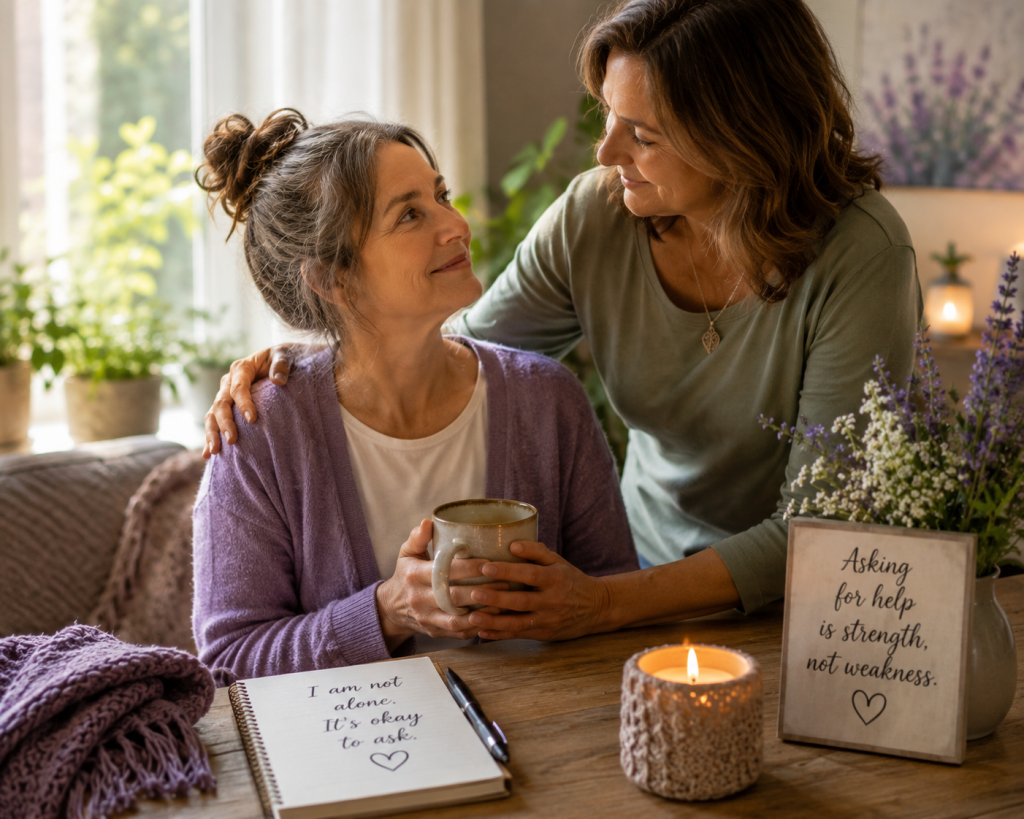
Learning to Ask for Help Without Losing Yourself

By Irene Roth/Blog Editor

For many people living with fibromyalgia, asking for help can feel surprisingly difficult. We may worry that others will see us as weak, incapable, or dependent. We may even fear that needing support somehow changes who we are.

But asking for help does not mean losing yourself. In many ways, it is one of the strongest expressions of self-awareness and self-respect.

Many of us spent years being the dependable one. We cared for our families, met deadlines, volunteered, supported friends, and kept going despite pain and exhaustion. Our identity became tied to what we could do for others. Then fibromyalgia arrived, quietly changing the rules.

Suddenly, carrying heavy groceries might trigger a flare. A simple afternoon of errands could require an entire day of recovery. Activities that once felt effortless now demand careful planning and pacing.

Accepting these changes is not easy.

Often, our first instinct is to push harder. We tell ourselves that we should be able to manage on our own. We compare ourselves to our past selves or to people who do not live with chronic pain. We continue saying yes when every part of us is asking for rest.

Eventually, though, our bodies remind us that they have limits.

Learning to ask for help is not about giving up your independence. It is about protecting it. Every time you allow someone to help with a task that drains your limited energy, you preserve that energy for the things that matter most—spending time with loved ones, enjoying a favourite hobby, taking a gentle walk, or simply making it through the day with less pain.

Help does not have to be dramatic. It might mean asking someone to pick up a prescription, carry laundry upstairs, prepare a meal, or drive you to an appointment. It may mean accepting an offer instead of automatically saying, “I’m fine.”

The truth is, most people appreciate having the opportunity to help someone they care about. We often extend compassion to others without hesitation, yet struggle to accept that same kindness ourselves. Imagine how you would respond if a friend with fibromyalgia asked you for assistance. You would likely help without judgment. You deserve that same grace.

It is also important to remember that asking for help does not erase your abilities. You are still intelligent, capable, creative, loving, and resilient. Your worth has never depended on how many tasks you complete in a day.

In fact, choosing when to ask for help requires wisdom. It means knowing your limits, respecting your body, and making thoughtful decisions that support your long-term well-being. That is not weakness—it is maturity.

Asking for help can also deepen relationships. It creates opportunities for connection, trust, and mutual care. Healthy relationships are not built on one person always giving and another always receiving. They thrive when support flows in both directions over time.

Perhaps the greatest lesson fibromyalgia teaches is that we were never meant to carry every burden alone.

You do not lose yourself when you accept a helping hand. Instead, you make room for the person you truly are—someone who values balance, honours their body’s wisdom, and understands that strength is not measured by how much you carry alone, but by how courageously you choose to care for yourself.


When My Inner Child Grew Up

by Shelley Taylor/Guest Blogger

At the grand age of 71, my inner child is finally catching up to my own age. She has been five years old for as long as I can remember.

There was a time when she stretched into her teenage years and embraced the thrill of young love, cigarettes, and patchouli oil. Those rich, exciting memories would tempt my inner child for short periods of time, especially on random hot summer days, only to ricochet her back into a terrified, vulnerable five-year-old once again.

She remained in that age range for decades—from five to sixteen—only shifting into adulthood when need and duty demanded it. She became a wife, a mother, a caregiver, and eventually a widow. Those roles required strength and responsibility, but deep inside, there was still a frightened little girl trying to make sense of the world.

Only in the past few years has my inner child truly grown into full womanhood. Now she is steadily evolving into the Wise Crone—the wise woman on the hill who provides a safe space for tea, light conversation, or the hard, heavy talks that draw pain and turmoil from those who need comfort, feedback, or simply someone to hold space for them.

My inner child is still learning. There is always more to discover, more ways to grow, and more wisdom to gather. She reminds me daily to stay in my own lane, remain humble, and love myself. She encourages me to make my own well-being a priority rather than an afterthought. Over time, she has become a trusted companion whose guidance I have learned to respect.

She is more than intuition. She is best friends with the Holy Spirit within me, and she is deeply connected to God. She is a safe voice to listen to, especially when life becomes complicated and noisy.

Except when she wants ice cream.

Then she’s a demanding, foot-stamping five-year-old all over again—and she usually wins.

Chocolate or strawberry?

Redefining Independence When You Live with Fibromyalgia

by Irene Roth/Blog Editor

When most people think about independence, they often picture someone who can do everything on their own. They imagine strength as self-sufficiency, productivity, and the ability to push through challenges without needing help. But when you live with fibromyalgia, independence often looks very different.

For fibromates, independence is not about doing everything. It is about making choices that honour your body, your energy, and your well-being. It is about learning that asking for help does not diminish your strength—it supports it.

Living with fibromyalgia requires constant decision-making. Every day begins with an assessment of how your body feels. You may wake up with enough energy to accomplish several tasks, or you may wake in the middle of a pain flare that changes every plan you had made. This unpredictability can make the traditional definition of independence feel frustrating or even unattainable.

But perhaps the definition itself needs to change.

True independence is having the freedom to listen to your body without guilt. It is deciding to rest when your body needs rest instead of forcing yourself to meet someone else’s expectations. It is recognizing that pacing is not giving up—it is a wise strategy that allows you to participate in life more consistently.

Independence also means becoming your own best advocate. Many people with fibromyalgia spend years explaining invisible symptoms to family members, employers, healthcare providers, and even friends. Learning to speak honestly about your needs takes courage. Saying, “I need to leave early,” “I can’t do that today,” or “I need a quieter environment” are acts of self-respect, not weakness.

There is also tremendous independence in learning what works uniquely for you. Perhaps you use assistive devices without embarrassment. Maybe you schedule appointments during your best hours of the day, prepare meals in stages, or divide household chores into smaller tasks. These adaptations are not signs that you are less capable. They are examples of creative problem-solving and resilience.

Many fibromates discover that independence also includes accepting support. Allowing a loved one to carry groceries, asking a neighbour for assistance, or using grocery delivery services does not mean you have failed. It means you are conserving precious energy for the activities that matter most to you. Sometimes the strongest decision is knowing when not to spend your limited energy.

Emotional independence is equally important. Fibromyalgia can invite comparisons with healthier versions of ourselves or with others whose lives appear easier. Over time, many people learn to release those comparisons. Instead of measuring success by how much they accomplish, they begin measuring it by how well they care for themselves, maintain meaningful relationships, and preserve their quality of life.

One of the greatest gifts of living with fibromyalgia is that it often teaches priorities with remarkable clarity. You learn that your energy is valuable. You become intentional about where you invest it. You begin choosing people, activities, and commitments that nourish rather than drain you.

Perhaps independence is not about never needing anyone.

Perhaps it is about having the wisdom to know what your body needs, the courage to honour those needs, and the confidence to build a life that reflects your values instead of society’s expectations.

For fibromates, independence is not measured by how much you can do alone. It is measured by how faithfully you care for yourself while continuing to create a meaningful, joyful life—one thoughtful choice at a time.